
Problem
The current requirements of the National Building Code of Canada (NBC) for sprinkler system design, construction and installation may result in increased costs and difficulties in sprinklering combustible concealed spaces, depending on the standard applied. Clause 3.2.5.12.(2)(a) permits all storeys of a building of residential occupancy throughout that is not more than 4 storeys in building height to be sprinklered in accordance with NFPA 13R, "Standard for the Installation of Sprinkler Systems in Low-Rise Residential Occupancies." NFPA 13R does not require combustible concealed spaces, including roof spaces, to be protected by sprinklers.
It is understood that the use of the word "throughout" within the context referred to in Clause 3.2.5.12.(2)(a) implies a building of Group C major occupancy containing no other major occupancies.
From the explicit use of "residential occupancy throughout," it could be inferred that where such a residential building also contains another major occupancy, the entire building would be required to be sprinklered in accordance with NFPA 13, "Standard for the Installation of Sprinkler Systems," including any combustible concealed spaces, unless otherwise exempted.
The term "throughout" is used in other Code provisions but in different contexts and with different related exemptions. For example, with respect to the installation of an automatic sprinkler system, Sentence 3.2.2.18.(1) clearly requires a building to be sprinklered "throughout," but exemptions are permitted in mixed-use cases, and some upper floors may not have to be sprinklered. In such cases, the need to sprinkler the upper floor(s) is typically based on the general construction requirements stated in Subsection 3.2.2. for each major occupancy.
Under Subsection 3.2.2., the upper floor of a 2-storey building containing a residential occupancy may not need to be sprinklered, while a mercantile (e.g., retail) occupancy present only on the ground floor might be required to be sprinklered in accordance with NFPA 13. But once the upper residential storey is sprinklered, either voluntarily or in accordance with a local bylaw or the construction requirements of NBC Subsection 3.2.2., then it also must be sprinklered in accordance with NFPA 13.
Using the term "throughout" in Clause 3.2.5.12.(2)(a) is unnecessarily restrictive, because it means that the requirement to install a sprinkler system applies throughout the entire building, instead of only applying to a particular storey in a building containing a residential occupancy.
Justification
The Standing Committee on Fire Protection reviewed provisions in the NBC on sprinklers and two standards: NFPA 13 and NFPA 13R. Justifications for the proposed change are presented as follows:
- Justifications 1–3: Justification for the use of NFPA 13 and NFPA 13R sprinkler systems in mixed-use buildings; and
- Justification 4: Justification for the proposed changes to the wording in Clause 3.2.5.12.(2)(a) and Note A-3.2.5.12.(2) based on discussions in Justifications 1–3.
Justification 1: Allowing Sprinkler Systems to be Used in Mixed Occupancy Buildings in Accordance with NFPA 13R
The 2019 edition of NFPA 13R incorporated changes to clarify the intent of the standard and to indicate that the standard is permitted to be used in mixed occupancy buildings. Annex Note A.1.1 of NFPA 13R states the following (emphasis added in bold):
Buildings that contain multiple occupancies (either separated or nonseparated), accessory occupancies, or incidental uses are often subject to special rules that might restrict the use of NFPA 13R. In buildings containing a residential occupancy properly separated from other occupancies, the use of NFPA 13R in the residential occupancy and NFPA 13 in the nonresidential occupancy(s) is appropriate. Refer to the adopted building code to determine whether such restrictions are applicable.
In the 2019 edition of the NFPA 13R Handbook, the notes to Subsection 1.1.1 further reinforce this point (emphasis added in bold):
For a building containing multiple occupancies utilizing the “separated” occupancy provisions in accordance with the applicable building code, residential occupancies are within the scope of NFPA 13R provided the building is not more than four stories in height, does not exceed 60 ft (18 m) in height above grade plane, and the residential occupancy is separated from the other occupancies in accordance with the “separated” occupancy requirements of the applicable building code. (For example, see 2018 NFPA 5000, Sections 6.2.2.3 and 6.2.4, and 2018 IBC [International Building Code] Section 508.4). In such cases, NFPA 13R can be used in the residential occupancies and NFPA 13 is to be used in the other nonresidential occupancies in the building.
Furthermore, the “Closer Look” feature in the “Enhanced Content” [1] of Subsection 1.1.1 of the 2022 edition of NFPA 13R (NFPA 13R-2022) also notes the following:
NFPA 13R and Residential Mixed Occupancy Buildings
Section A.1.1 clarifies that NFPA 13R systems can be used in residential mixed occupancy buildings.
[…] For a building containing multiple occupancies utilizing the “separated” occupancy provisions in accordance with the applicable building code, residential occupancies are within the scope of NFPA 13R provided the building is not more than four stories in height, does not exceed 60 ft (18 m) in height above grade plane, and the residential occupancy is separated from the other occupancies in accordance with the “separated” occupancy requirements of the applicable building code. In such cases, NFPA 13R can be used in the residential occupancies and NFPA 13 is to be used in the other nonresidential occupancies in the building.
A building containing multiple occupancies utilizing the “nonseparated” occupancy provisions of the applicable building code is not within the scope of NFPA 13R. For such a building, the applicable building code typically requires the use of an NFPA 13 system throughout the building […].
The “separated” occupancy provisions in Section 508.4 of the 2018 edition of the International Building Code (which is the "model" code for the United States) are analogous to the separation of major occupancies provisions in Article 3.1.3.1. of the NBC. Therefore, provided a residential occupancy is “separated” from other major occupancies in accordance with Article 3.1.3.1., it is understood that NFPA 13R would be permitted to apply to the residential portions of a building that is not more than 4 storeys in building height.
Justification 2: Allowing Residential Storeys Having an NFPA 13R System to be Located above or below the Non-Residential Storeys Sprinklered in Accordance with NFPA 13
Where one major occupancy is located above another major occupancy, Sentence 3.2.2.7.(2) allows the fire-resistance rating of the floor assembly between the major occupancies to be determined based on the requirements of Subsection 3.2.2. for the major occupancy located below. Therefore, Article 3.2.2.7. allows for the mixed application of Subsection 3.2.2., which can result in structural elements on the lower storeys of the building having lower fire-resistance ratings than the structural elements on the upper storeys.
A similar (storey-by-storey) approach should be considered for the requirements for sprinkler system design that allow storeys having an NFPA 13R system (i.e., storeys of residential major occupancy that are fire separated from all other adjoining major occupancies in accordance with Article 3.1.3.1.) to be located above or below the storeys sprinklered in accordance with NFPA 13, as illustrated schematically in Figure 1 for a hypothetical 4-storey building containing superimposed major occupancies.
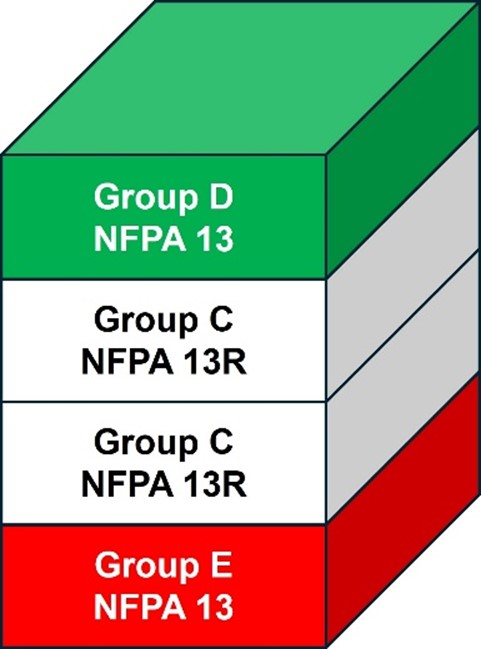
Figure 1. Four-storey building showing storeys in which NFPA 13R systems are installed and located above or below the storeys that are sprinklered in accordance with NFPA 13.
Justification 3: Allowing the Mixed Application of NFPA 13 and NFPA 13R Systems within the Same Storey
The 2025 NBC currently references the 2019 edition of NFPA 13R, which speaks to the intent of permitting the NFPA 13R sprinkler system design to be used in a mixed occupancy building. However, neither Annex Note A.1.1 of NFPA 13R nor the NFPA 13R-2019 Handbook specifically addresses the mixed application of NFPA 13 and NFPA 13R systems in the same storey, even when a portion of the storey that is of residential occupancy is fire separated from all other adjoining non-residential occupancies on the storey.
However, the “Closer Look” feature in the “Enhanced Content” [1] of Subsection 1.1.1 of NFPA 13R-2022 provides an example of how NFPA 13 and NFPA 13R systems would work in the same mixed-occupancy storey (note that the following text has been abbreviated):
Low-Rise Residential Applications and the Appropriate Sprinkler Standards
The types of buildings with low-rise residential occupancies can be essentially broken down to the following […] configurations in regard to NFPA 13R:
[…]
-
-
- Mixed or Multiple Occupancy Buildings. […] For a building containing multiple occupancies utilizing the separated occupancy provisions in accordance with the applicable building code, residential occupancies are within the scope of NFPA 13R, provided the building is not more than four stories in height, does not exceed 60 ft (18 m) in height above grade plane, and are separated from the other occupancies in accordance with the separated occupancy requirements of the applicable building code.
-
[…]
Consider the following examples:
[…]
A wood three-story apartment building [9000 ft2 (836 m2) per floor] has a 6000 ft2 (557 m2) clubhouse (A2 occupancy) located on the first floor. An NFPA 13R system is not appropriate for the assembly occupancy, so an NFPA 13 system is required. Assuming that the clubhouse is separated from the residential occupancy with the appropriate rating, the residential occupancy can be protected with an NFPA 13R system. The building will then have both an NFPA 13 and an NFPA 13R system installed. The assembly occupancy will follow the rules from NFPA 13, including sprinklers in combustible concealed spaces in that occupancy up to the required separation point. NFPA 13R, Section 7.5, does give guidance as to adjacent unprotected combustible concealed spaces.
Regardless of whether a building constructed in accordance with Clause 3.2.5.12.(2)(a) contains a single occupancy or multiple major occupancies, Paragraph 6.6.9.4 of NFPA 13R-2022 requires all interior stairways located outside the dwelling unit to be protected in accordance with NFPA 13.
As for buildings with mixed occupancies that are fire separated and contain both NFPA 13 and NFPA 13R systems, NFPA 13R-2022 provides clear guidance on the application of each standard to some common building elements shared by both residential and non-residential occupancies. For example, in the case of combustible concealed spaces without sprinkler protection, Section 7.5 of NFPA 13R-2022 does not require an increase in the design area, whereas NFPA 13 does require an increase in the design area in certain situations. However, the “Enhanced Content” [1] of Section 7.5 of NFPA 13R-2022 states the following:
[…] In buildings with separated mixed occupancies that contain both NFPA 13 and NFPA 13R systems, this [combustible concealed space] exception would apply only to the NFPA 13R occupancy. The separated occupancy protected in accordance with NFPA 13 would follow all the rules found in NFPA 13, which could include design area increases for nonsprinklered combustible concealed spaces.
Annex Note A.7.5 of NFPA 13R-2022 provides further insight by stating the following:
Where areas are protected in accordance with NFPA 13, NFPA 13 requirements for combustible concealed spaces are applicable.
Based on the foregoing, this proposed change would allow the application of NFPA 13R to extend not only to fully residential storeys but also to the portions of a storey that contain a residential occupancy, provided that the portions are fire separated from all other adjoining major occupancies and common areas, as described in other provisions of the NBC. Where a storey contains multiple major occupancies, the non-residential major occupancy portion of the storey would need to be sprinklered in accordance with NFPA 13.
In line with the approach discussed above in Justification 2, a mixed-occupancy storey may be located above or below any storey that is sprinklered in accordance with NFPA 13R and is either fully or partially residential. A mixed-occupancy storey may also be located above or below any storey sprinklered in accordance with NFPA 13. Figure 2 shows a schematic illustration of a hypothetical 4-storey building containing superimposed major occupancies with storeys containing mixed major occupancies.
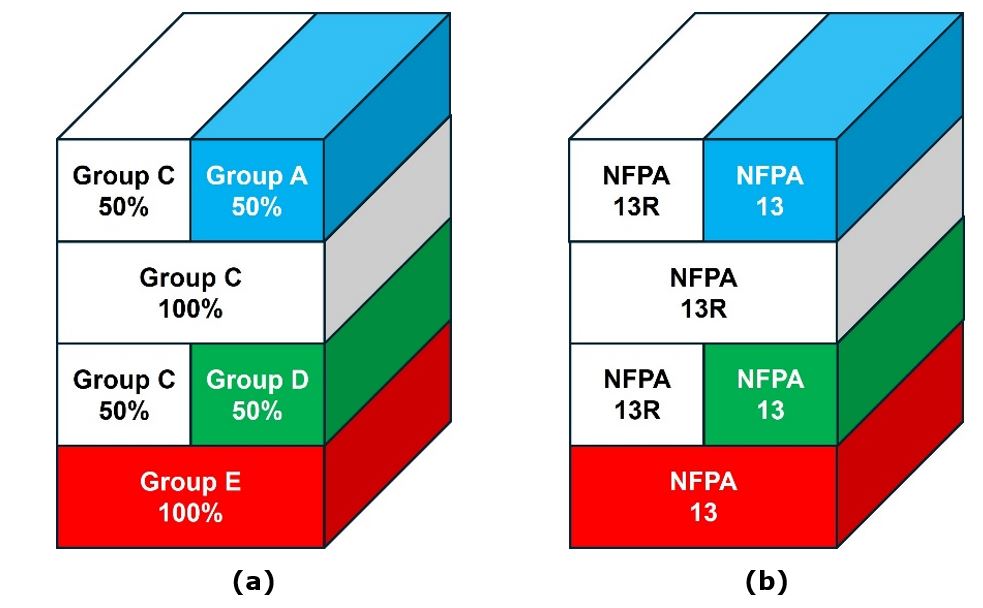
Figure 2. The use of NFPA 13 and NFPA 13R sprinkler systems in a 4-storey building containing non-residential, mixed-use and residential occupancies showing (a) the distribution of major occupancies in the building, and (b) the proposed application of sprinkler systems.
Justification 4: Amendments to Clause 3.2.5.12.(2)(a) and Appendix Note A-3.2.5.12.(2)
In line with the approach discussed in Justifications 1–3, it is no longer necessary to refer to Articles found in Subsection 3.2.2. in Subclause 3.2.5.12.(2)(a)(i) because this proposed change would allow NFPA 13R to be applied to fire-separated residential occupancies located in any building not more than 4 storeys in building height.
Furthermore, Subclause 3.2.5.12.(2)(a)(ii) references Article 9.10.1.3., which does not contain any provisions that are specific to building construction (unlike Subclause 3.2.5.12.(2)(a)(i), which does reference such Articles). Part 9 buildings are limited to a maximum building height of 3 storeys. Since this maximum height is within the subset of “buildings not more than 4 storeys in building height,” there is no longer a need for Subclause 3.2.5.12.(2)(a)(ii) and its reference to Part 9.
Consistent with the points raised in Justifications 1–4, this proposed change shortens Clause 3.2.5.12.(2)(a) by removing the Subclauses and aligns the wording used in Appendix Note A-3.2.5.12.(2) with the proposed wording in Clause 3.2.5.12.(2)(a).
Notes
[1] “Enhanced Content,” including its accessories “Closer Look” and “FAQ,” inter alia, is an interactive digital feature created specifically for NFPA LiNK® subscribers. It reflects expert commentary from NFPA handbooks for select publications that can be viewed inline with the standard’s text. For more information, please visit: https://www.nfpa.org/customer-support/will-nfpa-handbooks-be-in-nfpa-link.
PROPOSED CHANGE
[3.2.5.12.] 3.2.5.12.Automatic Sprinkler Systems
Note A-3.2.5.12.(2) Sprinklering of Residential Buildings above a Storage Garage Considered as a SeparateApplication of NFPA 13R to Certain Buildings.
Impact analysis
In a November 2020 article, the National Fire Sprinkler Association (NFSA) notes that unlike NFPA 13, NFPA 13R makes the installation of sprinkler systems more affordable and accessible for residential occupancies:
NFPA 13R further lowers costs by permitting a potentially lower level of water discharge than NFPA 13, which may result in smaller pipe sizes. NFPA 13 also calls for a greater density and spacing for sprinklers, as well as attic requirements that can significantly drive cost. Attic protection not only adds more sprinklers and piping, but the additional expenses associated with freeze protection, increased hydraulic demand, and water supply. [1]
According to the National Multifamily Housing Council in the United States, as reported in [1], the installation of NFPA 13R systems costs an average of CAD 15 to 30 less per square metre than NFPA 13 systems.
Adopting this proposed change would greatly reduce the capital costs associated with the design and installation of the sprinkler system, while continuing to maintain an acceptable level of fire safety.
Reference
[1] National Fire Sprinkler Association, “NFPA 13 vs. NFPA 13R in Podium and Mixed-Use Construction” (November 2020). https://nfsa.org/2020/11/17/nfpa-13-vs-nfpa-13r-in-podium-and-mixed-use-construction/
Enforcement implications
The enforcement implications are minimal, but fewer inspections would be needed for areas that are not sprinklered.
Who is affected
Designers, contractors and building inspectors would need to assess whether more restrictive requirements for the design of an automatic sprinkler system apply where buildings having mixed occupancies include residential occupancies.
OBJECTIVE-BASED ANALYSIS OF NEW OR CHANGED PROVISIONS
- Date modified: