Replace the Term "Hearing Impairment" with "People with Low or No Hearing"
Description:
This proposed change replaces the term "hearing impaired" with "people with low or no hearing" in Part 3.
Related Code Change Request(s):
CCR 1528
Related Proposed Change(s):
PCF 1342, PCF 1644
Problem
The terminology used in the National Building Code of Canada (NBC) to refer to people who are “hearing impaired” is outdated and should be updated to “people with low or no hearing.” This change would harmonize the terminology used in the building code requirements and explanatory Notes that relate to hearing levels.
This proposed change would facilitate a consistent interpretation of the Code requirements and reflect currently accepted terminology.
Justification
Replacing “people with a hearing impairment” with “people with low or no hearing” in the NBC is editorial in nature and will affect the clarity and understanding of the Code’s provisions but not their meaning, intent or application.
Using a consistent terminology supports consistent interpretation of the applicable requirements.
The Canadian Association of the Deaf and the Canadian Hard of Hearing Association list terms like “people who are deaf” (medical), “Deaf” (sociological), “hard of hearing” (covers a range of hearing levels) and “people with hearing loss” and qualify them based on levels of hearing and the types of communication styles that people use, and other factors. Terms referencing “impairment” are considered unacceptable. While some sources note that referencing “hearing loss” is acceptable, others suggest that it may have negative connotations.
For comparison, CSA/ASC B651, “Accessible design for the built environment,” refers to “people who are deaf, deafened or hard of hearing” and “people who are hard of hearing,” whereas CSA/ASC B652, “Accessible dwellings,” uses the term “low or no hearing.”
This proposed change would use the terminology “people with low or no hearing” in the NBC to focus on the functional aspects of hearing and the related need for building code requirements (e.g., the need for visible signals) without associating the terminology with a person’s identity or hearing level, or with the reason for or permanence of a person’s condition (e.g., disability, temporary injury or illness).
Although the National Model Codes aim to promote the use of consistent language, people’s experiences and terminology preferences related to hearing are subjective and varied.
PROPOSED CHANGE
[3.2.4.19.] 3.2.4.19.Visible Signals
[1] 1)Where a fire alarm system is installed, visible signal devices shall be provided in addition to alarm signal devices
[a] a)in buildings or portions thereof intended for use primarily by personspeople with alow or no hearing impairment,
[b] b)in assembly occupancies in which music and other sounds associated with performances could exceed 100 dBA,
[c] c)in any floor area in which the ambient noise level is more than 87 dBA,
[d] d)in any floor area in which the occupants
[i] i)use ear protection devices,
[ii] ii)are located in an audiometric booth, or
[iii] iii)are located in sound-insulating enclosures,
[e] e)in public corridors serving a Group B, C, D or E major occupancy,
[f] f)in corridors used by the public serving a Group A major occupancy,
[2] 2)Visible signal devices are permitted to be installed in lieu of audible signal devices in the compartments referred to in Article 3.3.3.6.
[3] 3)Visible signal devices required by Sentence (1) shall be installed so that the signal from at least one device is visible throughout the floor area or portion thereof in which they are installed. (See Note A-3.2.4.19.(3)PROPOSED CHANGE A-3.2.4.19.(3).)
Note A-3.2.4.19.(1)(g)Visible Alarm Signals in Hotels and Motels.
Visible signal devices should be installed in a combination of regular suites and designated accessible suites in hotels and motels so that people who are deafwith low or nohard of hearing can safely occupy either type of suite.
Visible signal devices are not required to be installed in all the rooms of the suite. The signal should be visible from any room in the suite, which can be accomplished by installing glazing panels between the rooms or additional visible signal devices.
In addition, CAN/ULC-S524, "Standard for Installation of Fire Alarm Systems", requires that high-intensity strobes be used in sleeping rooms.
[3.8.3.15.] 3.8.3.15.Water-Closet Stalls and Urinals for Persons with Limited Mobility
[3.8.3.16.] 3.8.3.16.Lavatories and Mirrors
[3.8.3.17.] 3.8.3.17.Showers
[3.8.3.18.] 3.8.3.18.Accessible Bathtubs
[3.8.3.19.] 3.8.3.19.Assistive Listening Systems
[3.8.3.20.] 3.8.3.20.Counters
[3.8.3.21.] 3.8.3.21.Telephones
[3.8.3.22.] 3.8.3.22.Spaces in Seating Area
Note A-3.8.Barrier-Free Design Principles.
This Section contains minimum requirements for the design of buildings that accommodate people with diverse abilities, across their lifespan, including, but not limited to, people who use wheelchairs or other assistive mobility devices (e.g., walking aids, canes, crutches, braces, prosthetics), people with personal care providers, people with hearinglow or no vision loss(see PCF 1644), people with low or no hearing, and people with service animals, so they can access and use buildings.
Examples of basic accessibility requirements of the Code are as follows:
a clear floor space of at least 800 mm by 1 350 mm,
a 1 000 mm clear width allowing a 90° turn,
a 2 100 mm diameter clear floor space allowing a 180° turn in one motion, and
a 1 700 mm diameter clear floor space allowing a 180° turn in multiple motions.
Note A-3.8.2.3.Access to Rooms and Facilities.
If barrier-free access is required into suites or rooms in Subsection 3.8.2., it is intended that access be provided, with some exceptions identified in Sentence 3.8.2.3.(2), throughout each room or suite. Some examples of where barrier-free access is required are as follows:
within each suite (subject to Clauses 3.8.2.3.(2)(k)and (l)),
within rooms or areas that serve the public or are designated for use by visitors, including areas in assembly occupancies with fixed seats, display areas and merchandising departments,
within rooms or areas for student use in assembly occupancies,
within general work areas, including office areas,
within general use or general service areas, including shared laundry areas in residential occupancies, recreational areas, cafeterias, lounge rooms, lunch rooms and infirmaries,
within sleeping rooms in hospitals and nursing homes with treatment,
(if installed), into at least one passenger elevator or elevating device conforming to Articles 3.5.2.1.and 3.8.3.7.,
into washrooms described in Sentences 3.8.2.8.(1)to (4),
to any facility required by this Section to be designed to accommodate persons with physical disabilities,
onto every balcony provided in conformance with Clause 3.3.1.7.(1)(c), and
to service counters used by the general public (examples include ticket counters, refreshment stands, drinking fountains, cafeteria counters, checkout counters and bank service counters).
The permission to waive a barrier-free path of travel for wheelchair access to certain specified areas of a building is not intended to waive accessibility requirements for personspeople whose physical disabilities do not require special provision for access to raised or sunken levels. PersonsPeople with visuallow or no vision (see PCF 1644) and people with low or no hearing disabilities thatwho do not require the use of a wheelchair can be expected to move throughout a building.
Seating booths and banquettes in restaurants and bars are considered furniture, which is beyond the scope of the Code. However, various types of seating should be considered to ensure the availability of barrier-free options.
The concept of wheelchair accessibility does not extend to building service facilities, nor to all floor levels within a storey, e.g., mezzanines not served by an elevator. Mezzanines that are accessible by an elevator are therefore not excluded.
Note A-3.8.3.9.(3)Accessibility Signs.
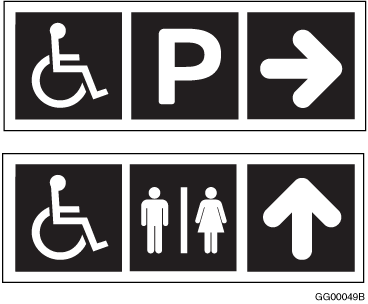
The International Symbol of Access shown in Figure A-3.8.3.9.(3)-A indicates to peoplepersons with physical disabilities that they will have reasonable freedom of movement within a building so signed. The symbol is usually white on a blue background; where these colours do not stand out, the sign can be set on a white background. An arrow can be added to indicate direction or the location of an accessible space or facility.
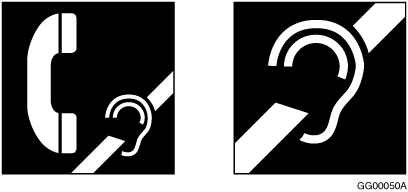
The International Symbol of Access for Hearing Loss shown in Figure A-3.8.3.9.(3)-B, which indicates accessibility for personspeople with low or no hearing loss, should be used to indicate the availability of variable volume controls on telephones, assistive listening systems, and text telephones (TT). These latter devices may also be referred to as teletypewriters (TTY) or telecommunications devices for the deaf (TDD).
Figure [A-3.8.3.9.(3)-B] A-3.8.3.9.(3)-B Signs for assistive listening facilities
Note A-3.8.3.19.Assistive Listening Systems.
Examples of assistive listening systems include FM, infrared and induction loop systems. However, the technology in this field is advancing rapidly; as such, other types of assistive listening systems could be considered in the design of a space. In choosing the most appropriate system, a number of factors must be taken into account including cost, installation and maintenance requirements, suitability for the intended user or audience, ease of operation, and the need for privacy. Information on designers and suppliers of such systems can be obtained from the Canadian Hearing Society. The intent of Article 3.8.3.19. is to provide clear communication where information, goods or services are provided to the public.
Wireless sound transmission systems, including FM, infrared and magnetic induction loop systems, improve sound reception for persons who are hard ofpeople with low or no hearing by providing amplification that can be adjusted by each user while blocking out unwanted background noise. Some of these systems transmit a signal that is picked up by a special receiver (FM, infrared) available for use by a person who is hard ofpeople with low or no hearing, whether or not a hearing aid is used. None of the systems interfere with the listening enjoyment of others.
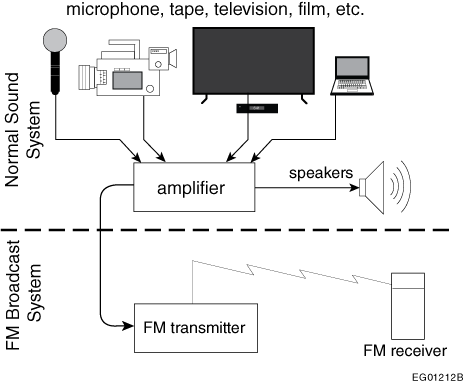
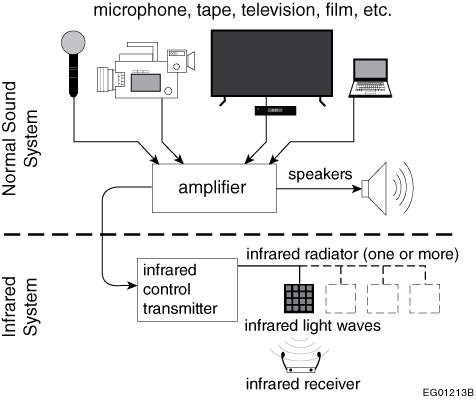
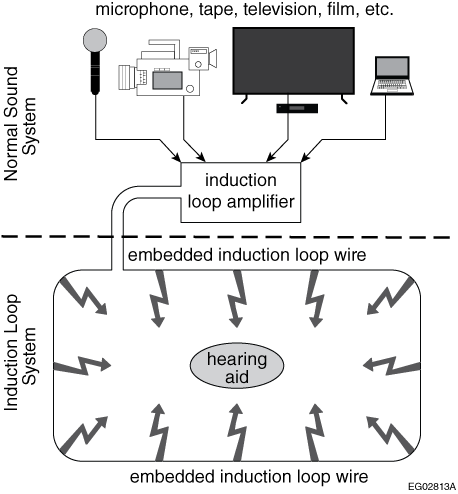
The transmitter can be connected into an existing public address (P.A.) system amplifier or used independently with microphones. The induction loop system (see Figure A-3.8.3.19.-C) requires people who users with a hearing aids or cochlear implants to be in the area circumscribed by the loop; though installation of the loop is relatively simple, the installer should be knowledgeable about these systems if proper functioning is to be achieved. FM and infrared systems can be designed to broadcast signals that cover the entire room and thus do not restrict seating to any one area. Figures A-3.8.3.19.-Aand A-3.8.3.19.-B show the general configuration of FM and infrared systems. Although portable systems (FM systems, in particular) are available, these are best suited to small audiences. Generally, the systems installed in church halls, auditoria, theatres and similar places of assembly are not easily portable, as they are installed in a fixed location by a sound technician and form an integral part of the P.A. system of the room or building.
Hard-wired systems (where a connection is provided at a particular seat in an auditorium, for example) might meet this requirement when adequate provisions are made to accommodate persons withpeople who use hearing aids.
Figure [A-3.8.3.19.-A] A-3.8.3.19.-A FM sound transmission systemFigure [A-3.8.3.19.-B] A-3.8.3.19.-B Infrared sound transmission systemFigure [A-3.8.3.19.-C] A-3.8.3.19.-C Induction loop sound transmission system
Impact analysis
The proposed change is editorial and does not affect building costs. The proposed change will support the consistent application of the Code requirements, facilitate understanding and interpretation of the Code provisions, and update the terminology to what is commonly used in the industry.
Enforcement implications
The revision of terminology is an editorial change that supports the consistent application of the Code requirements by building officials and designers.
Who is affected
Building officials, owners and designers will use a common terminology that would support consistent application of accessibility requirements and reflect more modern and accepted terminology.
OBJECTIVE-BASED ANALYSIS OF NEW OR CHANGED PROVISIONS
[3.2.4.19.] 3.2.4.19. ([1] 1)[F11-OS1.5]
[3.2.4.19.] 3.2.4.19. ([2] 2)no attributions
[3.2.4.19.] 3.2.4.19. ([3] 3)[F11-OS1.5]
[3.8.1.1.] 3.8.1.1. ([1] 1)no attributions
[3.8.1.1.] 3.8.1.1. ([2] 2)no attributions
[3.8.2.1.] 3.8.2.1. ([1] 1)no attributions
[3.8.2.2.] 3.8.2.2. ([1] 1)[F73-OA1]
[3.8.2.2.] 3.8.2.2. ([2] 2)no attributions
[3.8.2.2.] 3.8.2.2. ([3] 3)no attributions
[3.8.2.2.] 3.8.2.2. ([4] 4)[F73-OA1]
[3.8.2.3.] 3.8.2.3. ([1] 1)[F73-OA1]
[3.8.2.3.] 3.8.2.3. ([2] 2)no attributions
[3.8.2.3.] 3.8.2.3. ([3] 3)[F74-OA2]
[3.8.2.3.] 3.8.2.3. ([4] 4)[F74-OA2]
[3.8.2.3.] 3.8.2.3. ([5] 5)[F74-OA2]
[3.8.2.3.] 3.8.2.3. ([5] 5)[F10-OS3.7]Applies to portion of Code text: “... each row of seats served by two aisles shall have one adaptable seat conforming to Subsection 3.8.3. located adjacent to one of the aisles.”
[3.8.3.12.] 3.8.3.12. ([1] 1)([h] h)[F30-OS3.1]Applies to portion of Code text: “… be equipped with a coat hook … projecting not more than 50 mm from the wall …”
[3.8.3.12.] 3.8.3.12. ([1] 1)no attributions
[3.8.3.13.] 3.8.3.13. ([1] 1)[F74-OA2]
[3.8.3.13.] 3.8.3.13. ([1] 1)([b] b)[F10-OS3.7]
[3.8.3.13.] 3.8.3.13. ([1] 1)([c] c)
[3.8.3.13.] 3.8.3.13. ([1] 1)([d] d)
[3.8.3.13.] 3.8.3.13. ([1] 1)([f] f)
[3.8.3.13.] 3.8.3.13. ([1] 1)([g] g)[F30-OS3.1]Applies to the requirement for a coat hook.
[3.8.3.13.] 3.8.3.13. ([1] 1)([i] i)[F74-OA2]Applies to the requirement for a shelf.
[3.8.3.22.] 3.8.3.22. ([1] 1)[F30-OS3.1]Applies to portion of Code text: “… level … level and have removable seats, …”
[3.8.3.22.] 3.8.3.22. ([1] 1)([d] d)[F10-OS3.7]Applies to portion of Code text: “… without infringing on egress from any row of seating or any aisle requirements …”
[3.8.3.22.] 3.8.3.22. ([2] 2)[F74-OA2]
[3.8.3.22.] 3.8.3.22. ([2] 2)[F30-OS3.1]Applies to portion of Code text: “… level, ...”
[3.8.3.22.] 3.8.3.22. ([3] 3)([a] a)[F10-OS3.7]Applies to portion of Code text: “… without infringing on egress from any row of seating or any aisle requirements …”