
Accessibility, housing supply, and harmonization are among the priorities for the 2030 editions of Canada’s National Model Codes.
With the publication of the 2025 editions of the National Model Codes in December 2025, work on the 2030 Codes is already underway. The code development process includes strategic direction setting, work planning, change development, public reviews, and publication.
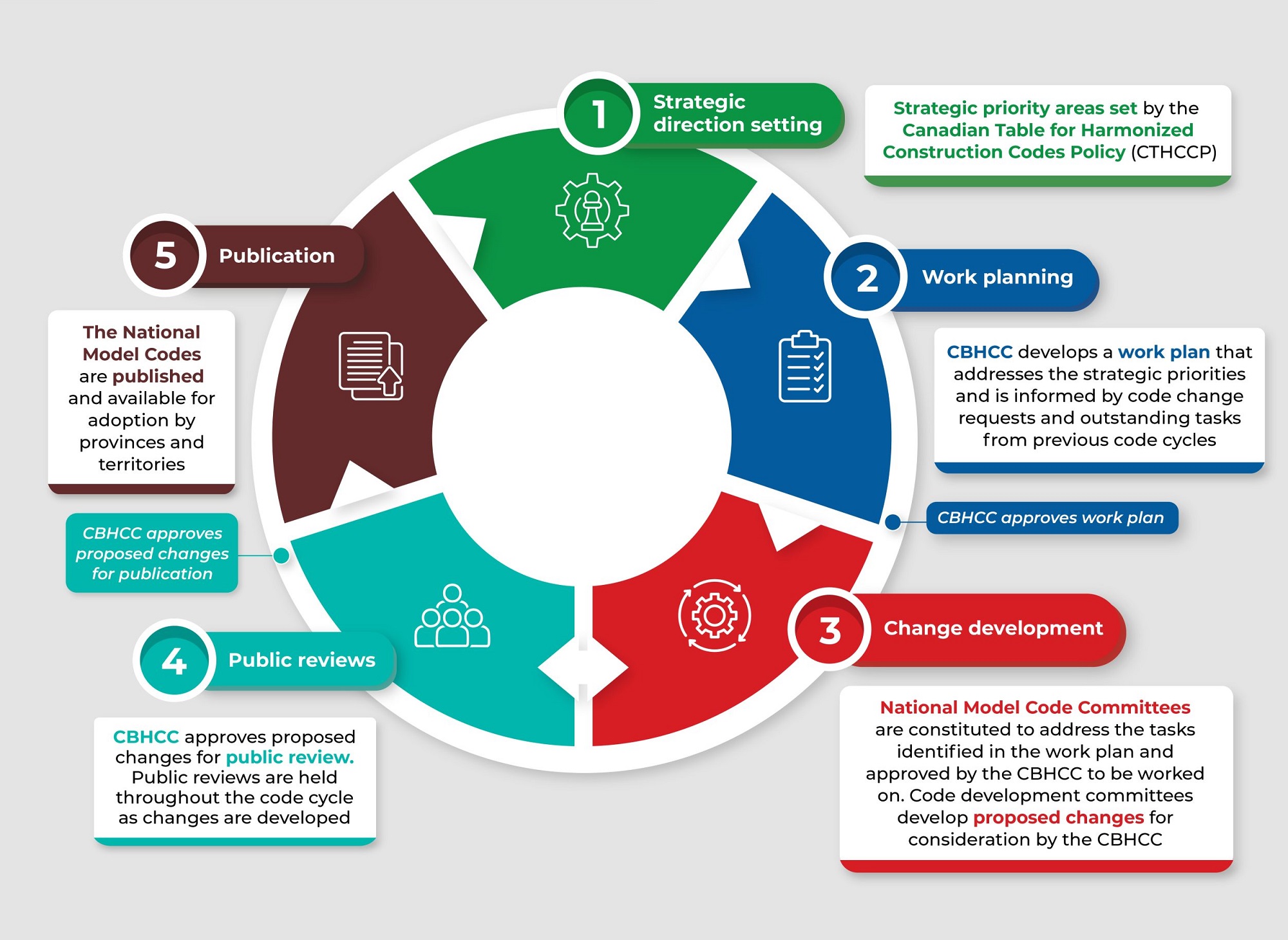
Long description of the infographic of the development process of Canada’s National Model Codes
This infographic illustrates the five-step process used by the Canadian Board for Harmonized Construction Codes (CBHCC) to develop Canada’s National Model Codes. The steps are arranged in a circular flowchart, with each step represented by a numbered segment of the circle. Each step is color-coded for differentiation.
Step 1: Strategic direction setting
- The first segment of the circle is green and positioned at the top.
- Inside this segment, there is a white icon depicting a gear with a light bulb inside it.
- A callout box to the right states:
- “Strategic priority areas are set by the Canadian Table for Harmonized Construction Codes Policy (CTHCCP).”
Step 2: Work planning
- The second segment, moving clockwise, is blue and located to the right of Step 1.
- This segment contains a white icon of a clipboard with a checklist.
- A blue callout box states:
- “CBHCC develops a work plan that addresses the strategic priorities and is informed by code change requests and outstanding tasks from previous code cycles.”
- Another blue callout at the edge of Step 2, where it transitions into Step 3, states:
- “CBHCC approves work plan.”
Step 3: Change development
- The third segment is red and located at the bottom right.
- A white icon of interlocking gears is placed inside this segment.
- A white callout box with red headings states:
- “National Model Code Committees are constituted to address the tasks identified in the work plan and approved by the CBHCC to be worked on. Code development committees develop proposed changes for consideration by the CBHCC.”
- At the transition between Step 3 and Step 4, a two-way arrow is present, indicating an iterative process between these two steps.
Step 4: Public Reviews
- The fourth segment is teal and positioned at the bottom left.
- This segment contains a white icon of a group of people.
- A white callout box with teal headings states:
- “CBHCC approves proposed changes for public review. Public reviews are held throughout the code cycle as changes are developed.”
- Where Step 4 transitions into Step 5, a teal callout states:
- “CBHCC approves proposed changes for publication.”
Step 5: Publication
- The final segment is brown and positioned at the top left.
- A white icon of stacked documents is displayed inside this segment.
- A white callout box with brown headings states:
- “The National Model Codes are published and available for adoption by provinces and territories.”
With input from volunteers, industry experts, interested organizations, and the public, the 2030 code cycle will build on the initiatives launched in 2025 while also advancing new ones. Committees will explore code changes that respond to the evolving needs of Canadians, while considering emerging technologies, materials, construction practices, and research.
Strategic priorities for the 2030 code cycle
To guide the work of volunteer National Model Codes Committees, the Canadian Board for Harmonized Construction Codes (CBHCC) developed a set of strategic priorities and potential areas of focus for the 2030 editions of the National Model Codes approved by the Canadian Table for Harmonized Construction Codes Policy. The 2030 code priorities include, with further details available online:
- Accessibility of buildings and dwellings: Continue developing provisions that increase the accessibility of buildings and dwellings for people with disabilities.
- Alterations to existing buildings: Continue to advance provisions for alterations to existing buildings, building on work completed for the 2025 National Model Codes.
- Climate change mitigation: Continue work on the development of code requirements for energy efficiency and greenhouse gas emissions, within the context of performance tiers, including the development of prescriptive solutions to support implementation.
- Climate change adaptation: Work to adapt the built environment in response to climate change, where the National Model Codes are identified as the appropriate instrument.
- Harmonization: Work to reduce and eliminate differences and variations between the National Model Codes and provincial and territorial codes in areas identified by the CBHCC. Harmonization of code requirements is an underlying priority of all code development activities for the 2030 Codes.
- Housing supply: Support efforts to increase housing supply by considering innovative construction methodologies, enabling additional construction options for housing, and supporting densification efforts.
- Performance-based solutions: Develop and add performance-based compliance options alongside the current prescriptive-based compliance options.
- Targeted topics: The CBHCC will continue to develop proposed changes, alongside the strategic priorities described above, to address the evolving needs of Canadians and to support the health, safety, and accessibility of homes and buildings, the protection of buildings from damage, and the protection of the environment.
Get involved in code development
There are several ways to get involved in the code development process and contribute to the 2030 editions of the National Model Codes.
Code change requests help inform the CBHCC’s work plan and the proposed code changes developed by National Model Codes Committees. Suggestions for changes to the Codes are welcome at any time and can be submitted through the CBHCC’s website.
Another opportunity to get involved is to participate in public reviews, which are generally held twice per year during the code cycle. The first public review of the 2030 code cycle is running from April 27 to June 22, 2026. More information will be shared on the CBHCC’s website and on LinkedIn.
Lastly, keep an eye on the CBHCC’s meeting calendar for upcoming public meetings, where attendees can observe or participate.