- Public review of proposed model code changes now open
 The Canadian Board for Harmonized Construction Codes (CBHCC) is inviting code users, interested parties, and the broader public to take part in the first public review of the 2030 code cycle. Proposed changes to the National Model Codes in this review address modular construction compliance and prescriptive compliance for Energy Performance Tier 2, among other key topics, including: Accessibility Airtightness Automatic sprinkler systems Drainage systems Fire protection Heating, ventilating, and air conditioning (HVAC) systems Plumbing materials and equipment The public review runs from April 27 to June 22, 2026. Those interested in participating in the review can access the proposed changes on the CBHCC website and provide feedback. The public review gives Canadians and interested organizations a chance to help shape the National Model Codes. After the review, comments will be assessed by the relevant code development committees and recommendations on the proposed changes will be made to the CBHCC. Approved changes will be included in the 2030 editions of
 - Introduction to the National Model Codes
 Understanding Canada’s National Model Codes and how to get involved in their development. What are the National Model Codes? The model construction codes are sets of model rules that outline how buildings must be designed, constructed and operated. They provide minimum requirements that builders and designers must follow once adopted in regulation. In Canada, the provinces and territories regulate the design and construction of houses and buildings. The National Model Codes serve as models for provincial and territorial regulations. The five documents that make up the National Model Codes are: National Building Code of Canada (NBC) National Plumbing Code of Canada (NPC) National Fire Code of Canada (NFC) National Energy Code of Canada for Buildings (NEBC) National Farm Building Code of Canada (last published in 1995) Who is the CBHCC? The National Model Codes are developed by the Canadian Board for Harmonized Construction Codes (CBHCC), an intergovernmental body composed of provincial, territorial, and federal government department representatives. The CBHCC is
 - Work on the 2030 editions of the National Model Codes is underway
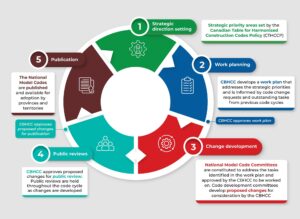 Accessibility, housing supply, and harmonization are among the priorities for the 2030 editions of Canada’s National Model Codes. With the publication of the 2025 editions of the National Model Codes in December 2025, work on the 2030 Codes is already underway. The code development process includes strategic direction setting, work planning, change development, public reviews, and publication. Long description of the infographic of the development process of Canada’s National Model Codes This infographic illustrates the five-step process used by the Canadian Board for Harmonized Construction Codes (CBHCC) to develop Canada’s National Model Codes. The steps are arranged in a circular flowchart, with each step represented by a numbered segment of the circle. Each step is color-coded for differentiation. Step 1: Strategic direction setting The first segment of the circle is green and positioned at the top. Inside this segment, there is a white icon depicting a gear with a light bulb inside it. A callout box to the right states:
 - How the National Model Codes facilitate the construction of more accessible homes and buildings
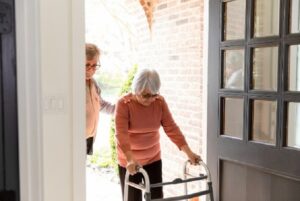 Accessibility continues to be a priority for the 2030 code cycle. For decades, the National Model Codes system has been working to create more accessible buildings through updates to the National Building Code. Each new edition contains provisions that aim to create barrier-free access to buildings across Canada. For instance, in the 2015 and 2020 editions of the National Building Code of Canada (NBC), several accessibility-related changes were introduced. These included updates to washroom fixtures and spaces, doorway dimensions, and other building elements to accommodate modern mobility aids and to improve accessibility and safety. This article summarizes provisions introduced in the 2025 edition of the National Building Code and looks ahead to accessibility-related work underway in the current code cycle. 2025 Code changes build on accessibility progress The code development cycle engaged participants from across Canada, including people with lived experience, industry experts, regulators, interested organizations, and the general public, leading to the publication of the 2025 editions of the
From our feed
 The 2025 editions of the NBC and the NECB introduce a national framework for reducing operational GHG emissions of houses and buildings.
View on LinkedIn
 The 2025 edition of the National Building Code of Canada (NBC) establishes minimum requirements to further minimize radon and soil gas infiltration in dwelling units and home-type care occupancies, making indoor air safer.
View on LinkedIn
 The 2025 editions of the National Building Code of Canada and the National Energy Code of Canada for Buildings introduce new energy efficiency requirements for alterations to existing buildings that aim to improve energy performance without placing undue burden on owners.
View on LinkedIn
 The 2025 editions of the National Building Code of Canada and the National Energy Code of Canada for Buildings incorporate projected climatic data so that the buildings we build today are designed for anticipated climate conditions.
View on LinkedIn
 Introducing accessibility features at the time of construction saves time and money when the needs of occupants change.
View on LinkedIn
On the agenda
For specific dates and meeting details, visit the CBHCC meeting calendar.
| April | Standing Codes Coordination Committee Virtual |
| May | Advisory Council for Harmonized Construction Codes Virtual National Model Codes Committee on Fire and Life Safety Virtual |
| June | National Model Codes Committee on Housing Supply Virtual Standing Codes Coordination Committee Virtual National Model Codes Committee on Indoor Environment Virtual |
| September | Advisory Council for Harmonized Construction Codes Virtual |