This proposed change updates the test method for and subsequent fire hazard classification of water-miscible liquid mixtures in the NFC.
Related Proposed Change(s):
PCF 2153
Problem
Some fire point data for water-miscible liquid mixtures (WMLMs) that appear in the National Fire Code of Canada (NFC) were taken directly from technical reports or papers, while others were estimated by adding 10°C to the flash point. However, the WMLM classifications in the NFC that are based on estimated fire points may not be accurate. Testing could yield different classifications than those in TableA-4.1.2.2., for example, which may confuse Code users.
The open-cup fire point test indicates the temperature at which vapours sustain continuous combustion for at least five seconds. While the open-cup fire point can be a useful measure, it may not be the best method for classifying WMLMs. Moreover, open-cup fire points are not consistently documented or included in safety data sheets, which makes such data hard to find and less user-friendly.
This proposed change specifies the that WMLMs should be classified in the same manner as other flammable and combustible liquids, using closed-cup flash points rather than the open-cup fire point method previously set out in the NFC.
Justification
To more accurately assess the fire risk associated with WMLMs and bring the NFC into alignment with other regulations, updates should be made to the test method for classifying these liquids in the NFC. This proposed change would classify them according to their closed-cup flash point.
The closed-cup flash point test is the global standard for fire risk assessment. This test method provides realistic hazard simulation by mimicking confined spaces, such as storage tanks and containers, where flammable vapours build up. The closed-cup flash point is used by the US Occupational Safety and Health Administration (OSHA), the US Department of Transportation (DOT), the National Fire Protection Association (NFPA), the Globally Harmonized System of Classification and Labelling of Chemicals (GHS), and the current NFC for the classification of flammable and combustible liquids. It should also be applied to WMLM classification.
To assess the fire risk posed by flammable WMLMs, closed-cup flash point data based on experiments or reliable literature should be used, avoiding assumptions and estimations.
Of the five WMLMs currently listed in NFC Sentence4.1.2.2.(1) (mixtures of methanol, ethanol, 2-propanol, acetone and acetic acid and water), none have a boiling point below 37.8°C (see Table1). This means that none are classified as ClassIA flammable liquids. The WMLMs posing the highest risk would be classified as ClassIB flammable liquids.
Table 1. Boiling Point of Solvents
Solvent
Boiling Point, °C
Methanol
65[1]
Ethanol
78[2]
2-Propanol
82.4[1]
Acetone
56[2]
Acetic acid
39[1]
This proposed change updates the classification of WMLMs in NFC Table4.1.2.2. based on closed-cup flash point testing. The test data for each WMLM are discussed below.
1. Methanol
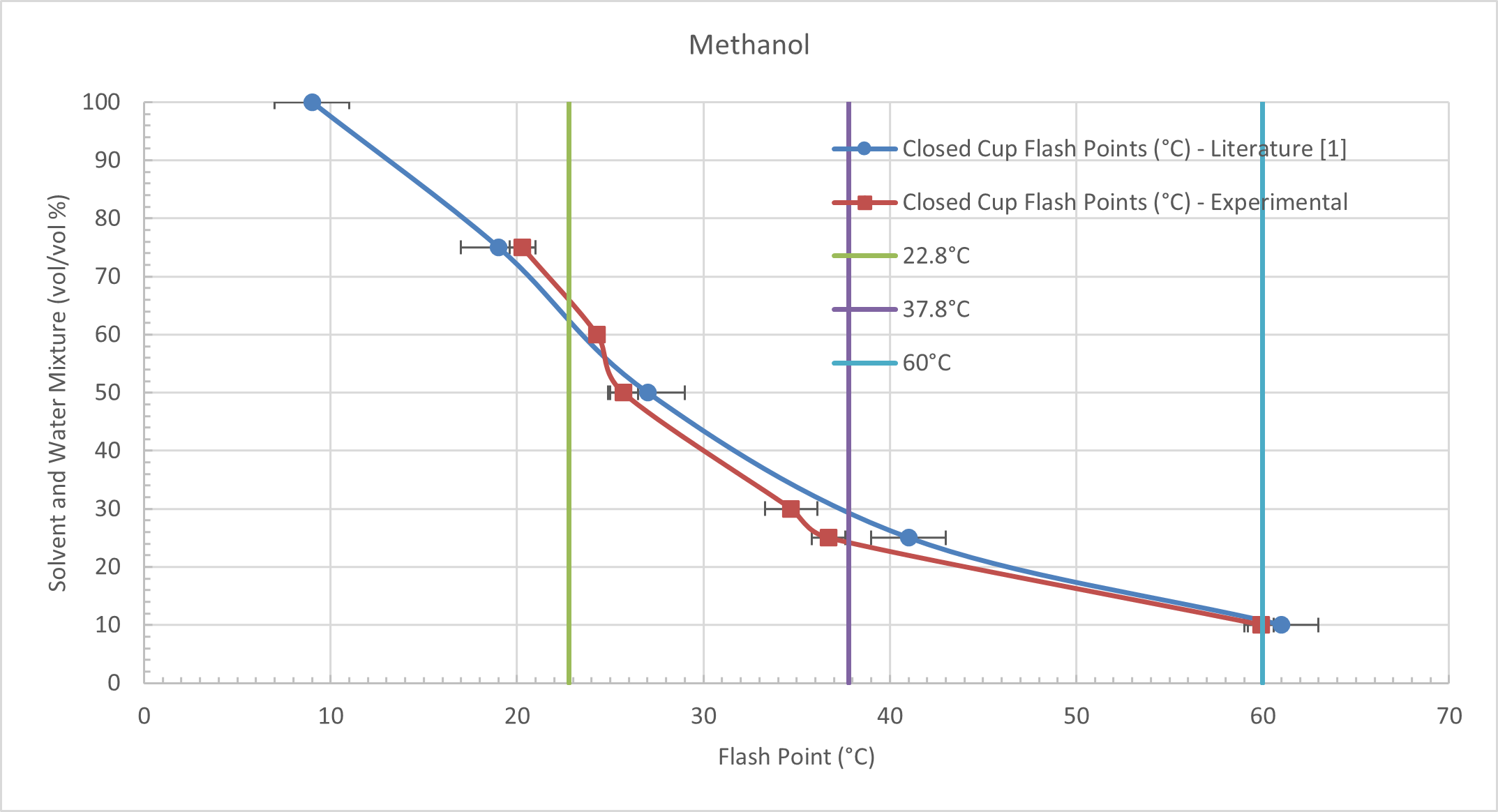
Sample mixtures of methanol and water were prepared at different concentrations and sent to Health Canada for closed-cup flash point testing. Figure1 plots the flash points obtained by Health Canada against the literature values.
Figure 1. Closed-cup flash points of methanol-water mixture
The literature values in Figure1 can be found in Table2.
Table 2. Closed-Cup Flash Points of Methanol-Water Mixture from Literature[1]
Methanol, % v/v
Closed-Cup Flash Point, °C
Uncertainty, +/-°C
100
9
2
75
19
2
50
27
2
25
41
2
10
61
2
As demonstrated in Figure1, the experimental data from Health Canada are in reasonable alignment with the values from the literature.
2. Ethanol
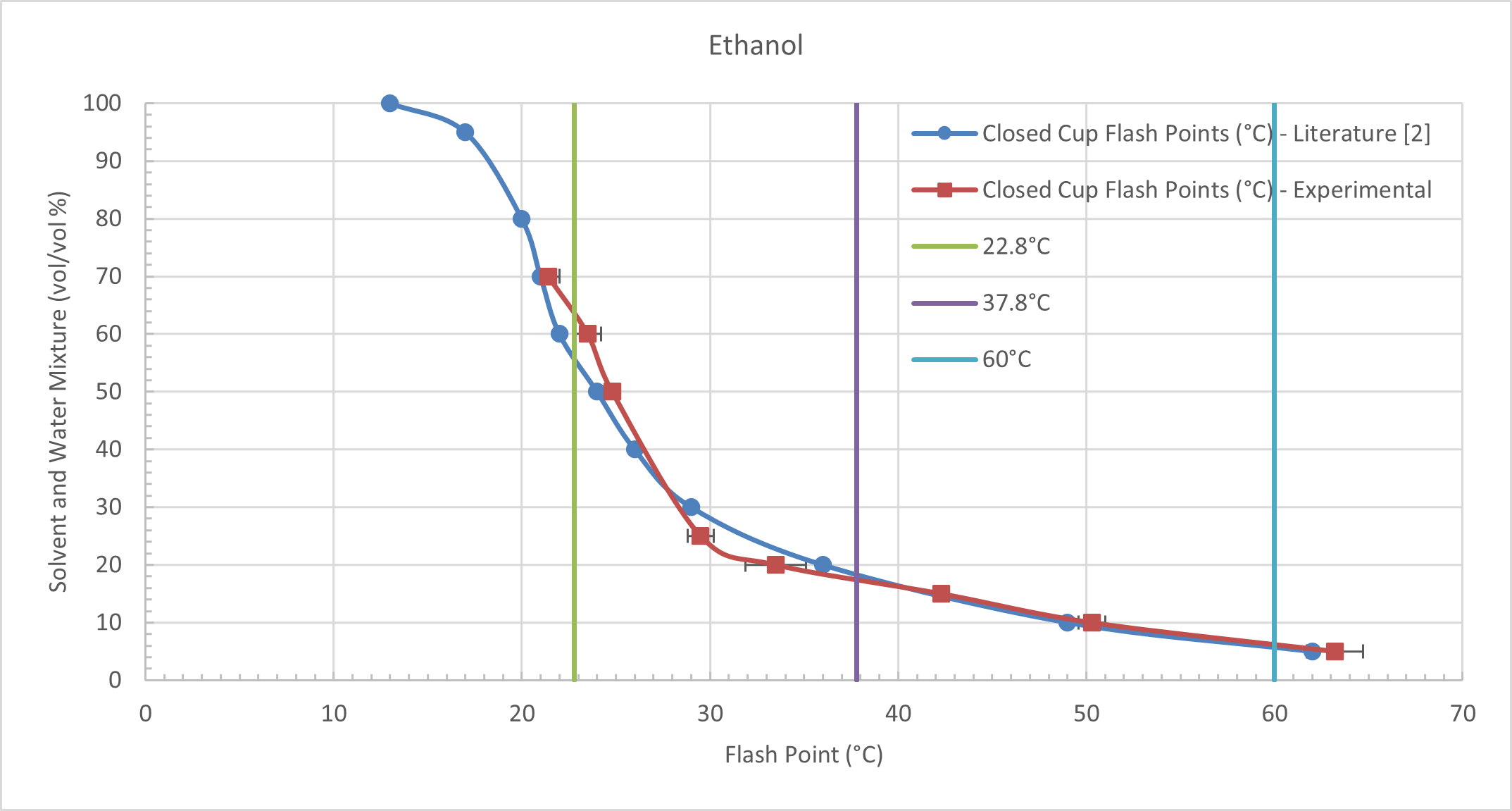
Similarly, sample mixtures of ethanol and water at different concentrations were tested by Health Canada to determine their closed-cup flash points, which are cross-referenced with the values based on published literature in Figure2 [2].
Figure 2. Closed-cup flash points of ethanol-water mixture
The literature data in Figure2 can be found in Table3.
Table 3. Closed-Cup Flash Points of Ethanol–Water Mixture from Literature [2]
Ethanol, % v/v
Closed-Cup Flash Point, °C
100
13
95
17
80
20
70
21
60
22
50
24
40
26
30
29
20
36
10
49
5
62
As demonstrated in Figure2, the experimental data from Health Canada are in close alignment with that from the literature.
3. 2-Propanol
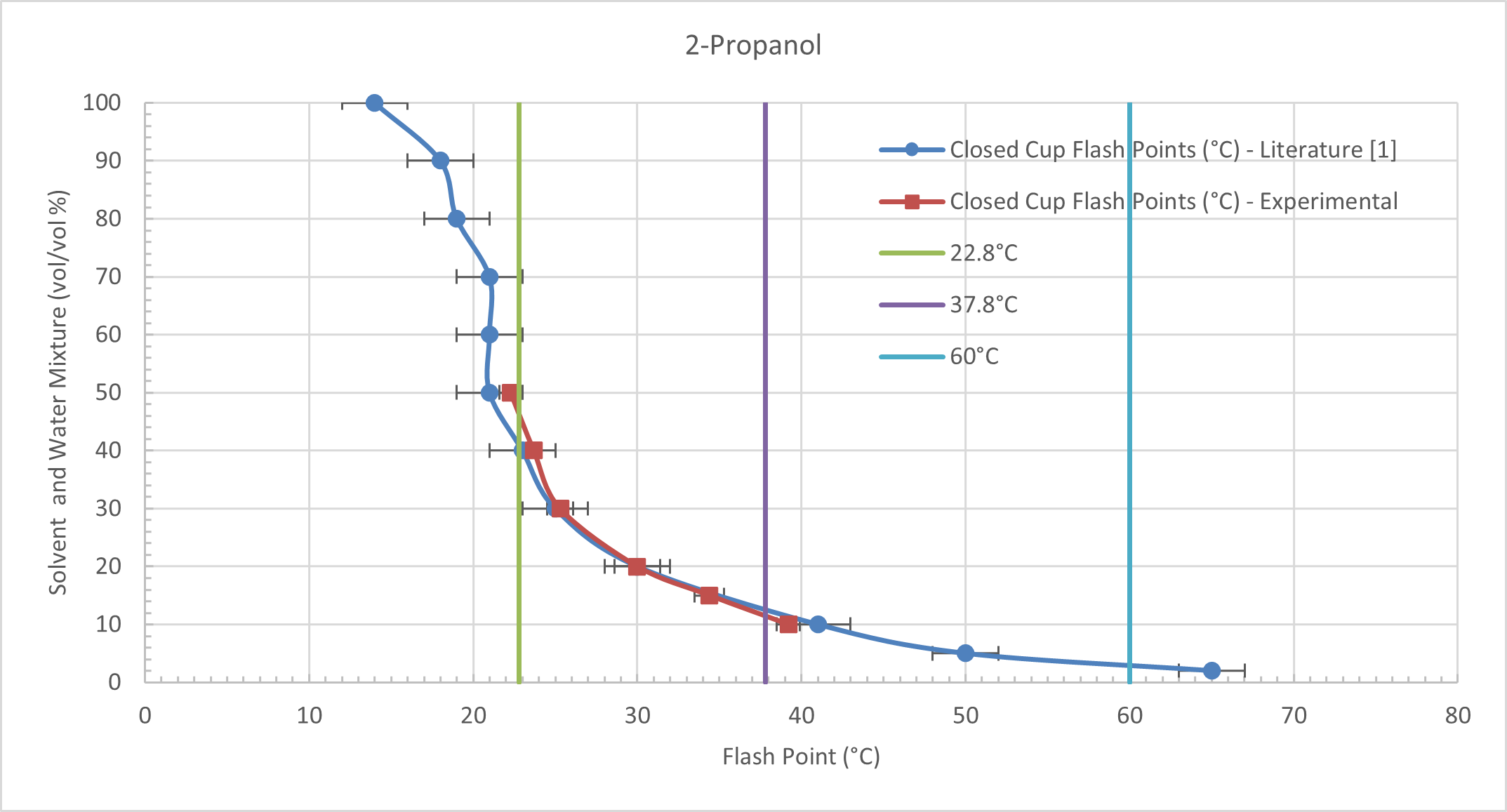
Sample mixtures of 2-propanol and water at different concentrations were tested by Health Canada to determine the closed-cup flash points, which are cross-referenced with the values based on published literature in Figure3 [1].
Figure 3. Closed-cup flash points of 2-propanol–water mixture
The literature data in Figure3 can be found in Table4.
Table 4. Closed-Cup Flash Points of 2-Propanol–Water Mixture from Literature[1]
2-Propanol, % v/v
Closed-Cup Flash Point, oC
Uncertainty, +/-°C
100
14
2
90
18
2
80
19
2
70
21
2
60
21
2
50
21
2
40
23
2
30
25
2
20
30
2
10
41
2
5
50
2
2
65
2
As shown in Figure3, the experimental data from Health Canada confirm the reliability of the data from the literature [1].
4. Acetone
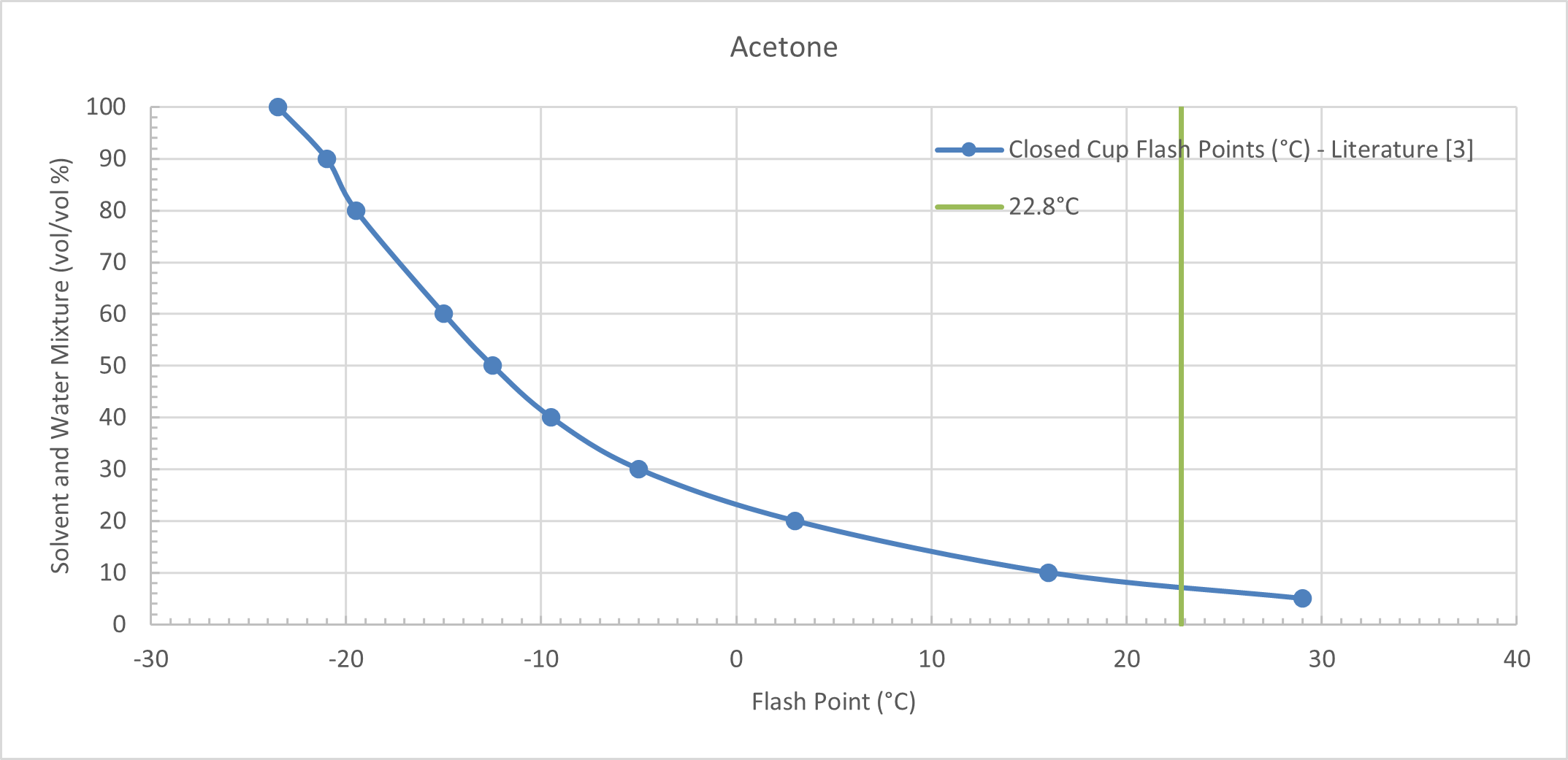
The closed-cup flash points of the acetone–water mixture at different concentrations can be found in Reference[3]. Figure4 and Table5 summarize the data.
Figure 4. Closed-cup flash points of acetone–water mixture
Table 5. Closed-Cup Flash Points of Acetone–Water Mixture from Literature [3]
Acetone, %v/v
Closed-Cup Flash Point, oC
100
–23.5
90
–21
80
–19.5
60
–15
50
–12.5
40
–9.5
30
–5
20
3
10
16
5. Acetic Acid
The 100% acetic acid liquid has a closed-cup flash point of about 39.5°C [1][3], which classifies it as Class II liquid under NFC Subsection4.1.2. Mixing it with water further lowers the fire risk of the solvent [3]. The current classification of the acetic acid and water mixture as Class IB seems to overestimate the fire risk of this WMLM. Moreover, mixtures of acetic acid and water are not commonly used by industry or commonly available on the market, except at low acid concentrations in vinegar (at 4% to 30% by volume, depending on the application) and marinades (1% to 2% by volume). None of these uses have raised any fire risk concerns. Therefore, this proposed change would remove the acetic acid and water mixture from the classifications in NFC Article4.1.2.2. and the explanatory NoteA-4.1.2.2.
Based on NFC Subsection4.1.2. and the data from closed-cup flash point tests in the literature, and by interpolating between the relevant data points, the classification of WMLMs in the NFC (i.e., mixtures of methanol, ethanol, 2-propanol acetone and water) should be updated as shown in the revised TableA-4.1.2.2.-2030.
References
[1] Astbur G., Bugand-Bugandet J., Grollet E., and Stell K., “Flash Points of Aqueous Solutions of Flammable Solvents,” IChemE Symposium Series No. 150, pp. 1–18, 2004.
[2] National Fire Protection Association, Fire Protection Guide to Hazardous Materials, Eds. Spencer A.B. and Colonna G.R., 2002.
[3] Janès A. and J. Chaineaux, “Experimental Determination of Flash Points of Flammable Liquid Aqueous Solutions,” Chemical Engineering Transactions, vol. 31, 2013.
[1] 1)Except as provided in Article 4.1.2.2., fFor the purposes of this Part, flammable liquids and combustible liquids shall be classified in conformance with Sentences (2)and (3).
[2] 2)Flammable liquids shall be Class I liquids, and shall be subdivided into:
[a] a)Class IA liquids, which shall include those having a closed-cupflash point below 22.8°C and a boiling point below 37.8°C,
[b] b)Class IB liquids, which shall include those having a closed-cupflash point below 22.8°C and a boiling point at or above 37.8°C, and
[c] c)Class IC liquids, which shall include those having a closed-cupflash point at or above 22.8°C and below 37.8°C.
[3] 3)Combustible liquids shall be Class II or Class IIIA liquids, and shall be subdivided into:
[a] a)Class II liquids, which shall include those having a closed-cupflash point at or above 37.8°C and below 60°C, and
The classification system for flammable liquids used by TC SOR/2001-286, "Transportation of Dangerous Goods Regulations (TDGR)", differs from the NFPA classification system used in the NFC. In the NFC, only liquids with a closed-cup flash point below 37.8°C are referred to as “flammable liquids,” whilereas liquids having a closed-cup flash point at or above 37.8°C are referred to as “combustible liquids.” The TDGR do not include Class IIIA liquids, which have a closed-cup flash point above 60°C.
For the purpose of comparing the TDGR classification system with the NFC system, the difference between 60.5°C (TDGR) and 60°C (NFC) may be ignored. The results of closed-cup flash point tests may vary by as much as 1°C, so nothing is gained by unnecessary precision.
Note A-4.1.2.1.(3)(b)
The NFPA classification system for flammable and combustible liquids includes Class IIIB liquids, which have closed-cup flash points at or above 93.3°C. These liquids are not regulated by Part 4 of the NFC because they are deemed to represent no greater fire hazard than other combustibles, such as wood or paper products. However, Article 4.1.2.3. clarifies that such liquids are effectively Class I liquids when heated to their closed-cup flash point temperature.
[1] 1)For the purposes of this Part, mixtures of methanol, ethanol, 2-propanol,or acetone or acetic acid and water shall be classified in conformance with Sentences (2) to (6)(5).
[2] 2)A mixture of methanol and water shall be classified as
[a] a)a Class IB liquid if the concentration of methanol is 9063% or more by volume,
[b] b)a Class IC liquid if the concentration of methanol is 30% or more but less than 9063% by volume, or
[c] c)a Class II liquid if the concentration of methanol is 2010% or more but less than 30% by volume.
[3] 3)A mixture of ethanol and water shall be classified as
[a] a)a Class IB liquid if the concentration of ethanol is 9056% or more by volume,
[b] b)a Class IC liquid if the concentration of ethanol is 3018% or more but less than 9056% by volume, or
[c] c)a Class II liquid if the concentration of ethanol is 205% or more but less than 3018% by volume.
[4] 4)A mixture of 2-propanol and water shall be classified as a Class IC liquid if the concentration of 2-propanol is 20% or more by volume.
[a] --)a Class IB liquid if the concentration of 2-propanol is 41% or more by volume,
[b] --)a Class IC liquid if the concentration of 2-propanol is 12% or more but less than 41% by volume, or
[c] --)a Class II liquid if the concentration of 2-propanol is 3% or more but less than 12% by volume.
[5] 5)A mixture of acetone and water shall be classified as a Class IB liquid if the concentration of acetone is 5% or more by volume.
[a] --)a Class IB liquid if the concentration of acetone is 7% or more by volume, or
[b] --)a Class IC liquid if the concentration of acetone is less than 7% by volume.
[6] 6)A mixture of acetic acid and water shall be classified as a Class IB liquid if the concentration of acetic acid is 8% or more by volume.
Note A-4.1.2.2.
According to research and test results, mixtures containing less than 210% by volume methanol, less than 5% by volume ethanol, or less than 3% by volume 2-propanol,less than 5% by volume acetone, or less than 8% by volume acetic acid in water are unlikely to present a fire hazard. While these water-miscible liquid mixtures still have closed-cup flash points, they may not be able to develop sustained burning because of the presence of water in the mixtures. Therefore, these mixtures are not classified as flammable or combustible liquids. They may, however, be classified as dangerous goods to which the requirements of Part 3 would apply.
The closed-cup flash points and fire points of water-miscible liquid mixtures depend on the concentration of the water-miscible liquid. The classifications noted in Article 4.1.2.2. for mixtures of methanol, ethanol, 2-propanol,or acetone or acetic acid and water, which are summarized in Table A-4.1.2.2., take into account the closed-cup flash points and fire points of the mixtures at various concentrations of the water-miscible liquid, as well as their unique fire and chemical properties.
Table [4.1.2.2.] A-4.1.2.2. Classification of Mixtures of a Water-Miscible Liquid and Water Forming Part of Note A-4.1.2.2.PROPOSED CHANGE A-4.1.2.2.
SolventVolume Concentration of the Water-Miscible Liquid, %
Classification
Class IB
Class IC
Class II
Volume Concentration Range of the Solvent in Water-Miscible Liquid, % v/v
Methanol
≥ 63
≥ 30 and < 63
≥ 10 and < 30
≥ 90
✓
—
—
≥ 30 and < 90
—
✓
—
≥ 20 and < 30
—
—
✓
Ethanol
≥ 56
≥ 18 and < 56
≥ 5 and < 18
≥ 90
✓
—
—
≥ 30 and < 90
—
✓
—
≥ 20 and < 30
—
—
✓
2-Propanol
≥ 41
≥ 12 and < 41
≥ 3 and < 12
≥ 20
—
✓
—
Acetone
≥ 7
< 7
—
≥ 5
✓
—
—
Acetic acid
≥ 8
✓
—
—
It is impractical for every type and concentration of water-miscible liquid mixture to be classified in the Code. The classification of a mixture not covered in Article 4.1.2.2. can be determined by measuring its fireclosed-cup flash point using the open-cup test described in ASTM D92, "Standard Test Method for Flash and Fire Points by Cleveland Open Cup Tester",in accordance with Subsection 4.1.3., and then classifying it in accordance with Sentences 4.1.2.1.(2)and (3).by treating the measured fire point as the flash point of the mixture. This procedure should also be followed to determine the classification of a mixture containing multiple water-miscible liquids and water, as the flash point and fire point of the mixture are likely to differ from those of each water-miscible liquid in water. (Note that closed-cup tests are used to determine the flash points of pure liquids.)
Impact analysis
The impact of this proposed change is expected to be minimal.
The deletion of the classification of the acetic acid and water mixture in this proposed change would provide relief for Code users who handle and store acetic acid and water mixtures as currently required by the NFC. For example, a mixture of 10% acetic acid and water is commonly used and sold as “cleaning vinegar” in Canada. Any acetic acid and water mixture with a concentration of acetic acid higher than 8% by volume is currently classified as a ClassIB liquid in the NFC, so restrictions regarding maximum quantities, clearance and storage location have to be followed instead of Part4 requirements, which could be more stringent than necessary in sprinkler protection, spill containment, etc.
Due to the variety of real-life situations, however, the exact or average compliance cost savings cannot be calculated.
Enforcement implications
This proposed change can be enforced by the infrastructure currently available. The proposed change simply updates the test method and the classification of WMLMs in the NFC.
Who is affected
Regulators, engineers, building owners, contractors, fire services, and certain businesses using and storing WMLMs.
OBJECTIVE-BASED ANALYSIS OF NEW OR CHANGED PROVISIONS