This proposed change updates energy modeling rules for heat pumps for the reference house and Energy Performance Tier 1, and adds a percent heat loss reduction requirement for Tier 1.
Problem
Heat pumps are treated as an energy source in Sentences9.36.6.15.(2) and 9.36.6.16.(1) of the National Building Code of Canada (NBC). However, this treatment could cause confusion, as heat pumps can be powered by electricity or gas, which are also listed as energy sources. To provide clarity, heat pumps should be treated as a type of equipment.
Currently, the modeling rules for heat pumps in Subsection9.36.6. and Energy Performance Tier1 are inconsistent when compared to Energy Performance Tiers2 to 5. However, Subsection9.36.6. and Tier1 require the Code user to model the energy performance of a heat pump in both the reference and proposed houses when a heat pump is installed in the proposed house. When a heat pump is installed in the proposed house, Sentence9.36.7.3.(2) permits comparison with equipment of the same type as its secondary or back-up system in the reference house. As a result, Code users are credited for the energy savings provided by a heat pump compared to less efficient space-heating equipment, but only in higher Energy Performance Tiers.
Removing the requirement from Sentence9.36.7.3.(2) to model a heat pump in the reference house for Tier1 could permit a 30% decrease in the building envelope performance of the proposed house, compared to a building envelope designed according to Subsection9.36.2. In order to maintain an acceptable minimum performance of the building envelope, a heat loss reduction target for Tier1 should be added to Table9.36.7.2.
The NBC also includes inconsistent modeling rules for service water heating as compared to space heating. For space heating in Tiers2 to 5, the efficiency of a heat pump in the proposed house is allowed to be compared to that of the back-up heating system in the reference house. However, for service water heating in all tiers, the efficiency of a heat pump water heater in the proposed house must be compared to that of a heat pump water heater in the reference house. As a result, an energy performance credit is not provided for the more efficient heat pump service water heaters (compared to storage-type service water heaters).
Justification
This proposed change removes heat pumps from the list of energy sources used for energy modeling, which would allow energy efficiency improvements to be recognized when comparing different types of HVAC or service water heating equipment and their respective efficiencies.
Removing the exception for Tier1 from Sentence9.36.7.3.(2) would allow Code users to be credited for the expected energy savings that result from the installation of a heat pump in compliance with the Code.
Adding a requirement for heat loss reduction of ≥0% in Tier1 to Table9.36.7.2. would limit the risk of the design of deficient building envelopes where a heat pump is installed in a proposed house complying with Energy Performance Tier1.
Adding new Sentence9.36.7.3.(3)-2030, which allows heat pump water heaters to be compared to storage-type service water heaters of the same energy source in the reference house, would permit Code users to benefit from the increased energy savings related to the performance of the heat pump water heater. As a result, this proposed change would also remove the discrepancy between heat pumps that are used for space heating and service water heating.
PROPOSED CHANGE
[9.36.6.15.] 9.36.6.15.Modeling HVAC System of Reference House
[1] 2)The energy model calculations for the reference house shall include the same features as those used for the proposed house with regard to
[a] a)the principal heating and cooling energy sources, which are gas, electricity, oil, propane,or wood or a heat pump,
[b] b)the primary and secondary energy sources, which are gas, electricity, oil, propane,or wood or a heat pump, and
[c] c)the ventilation rate (see Sentence 9.36.6.11.(6)).
(See Note A-9.36.6.15.(2) and 9.36.6.16.(1).)
Note A-9.36.6.15.(2) and 9.36.6.16.(1)Primary and Secondary Energy Sources.
Energy sources for the principal heating and cooling systems and for the service water heating systems do not include heat pumps or renewable energy generation sources.
[9.36.6.16.] 9.36.6.16.Modeling Service Water Heating System of Reference House
[1] 1)The energy source of the reference house's service water heating system, which is gas, electricity, oil, propane,or wood or a heat pump, shall be the same as that for the system in the proposed house. (See Note A-9.36.6.15.(2) and 9.36.6.16.(1).)
Table [9.36.7.2.] 9.36.7.2. Energy Performance Tiers for Buildings and Houses Forming Part of Sentence 9.36.7.2.(1)
Total Volume of Conditioned Space Within the Building or House
[1] 1)Except where otherwise stated in this Article, the proposed and reference houses shall be modeled in accordance with Subsection 9.36.6. to determine
[a] a)the annual energy consumption of the proposed house and the house energy target of the reference house,
[b] b)the annual gross space heat loss of the proposed and reference houses calculated in accordance with Sentence (3), and
[c] c)the peak cooling load of the proposed and reference houses.
(See Note A-9.36.7.3.(1)PROPOSED CHANGE A-9.36.7.3.(1).)
[2] 2)Except for energy performance tier 1, wWhere space heating is provided by a heat pump in the proposed house, the reference house shall be modeled using
[a] a)equipment of the same type as the secondary or back-up system in the proposed house, but made to comply with the energy efficiency requirements of Article 9.36.3.10., or
[b] b)electric resistance heaters, where no back-up is provided in the proposed house.
[3] --)Where service water heating is provided by a heat pump water heater in the proposed house, the reference house shall be modeled using a storage-type service water heater that complies with the energy efficiency requirements in Article 9.36.4.2. that
[a] --)has the same energy source as the heat pump water heater, or
[b] --)is gas-fired, if the energy source of the heat pump water heater is not included in Table 9.36.4.2.
[4] 3)The annual gross space heat loss shall be calculated as the sum of the cumulative heat loss from
[a] a)conduction across opaque and transparent elements of the building envelope,
[5] 4)The percent heat loss reduction shall be calculated by subtracting the annual gross space heat loss of the proposed house from the annual gross space heat loss of the reference house and dividing the result by the annual gross space heat loss of the reference house.
[6] 5)The percent improvement shall be calculated by subtracting the annual energy consumption of the proposed house from the house energy target of the reference house and dividing the result by the house energy target of the reference house.
[7] 6)The percent house energy target shall be calculated by dividing the annual energy consumption of the proposed house by the house energy target of the reference house.
[8] 7)The airtightness value used in the energy model for the proposed house shall be
[a] a)the airtightness value set out in Clause 9.36.6.10.(9)(a), or
[b] b)where an airtightness test is to be conducted, a design airtightness, until the airtightness has been measured in accordance with Sentence 9.36.5.3.(1) and the appropriate airtightness value set out in Sentence 9.36.6.10.(9) can be selected.
The annual gross space heat loss has been selected as a good proxy for heat loss due to building envelope performance. It is readily extracted from building simulation models and correlates well with the combined conductive (through both fenestration and opaque elements) and air leakage losses, while excluding solar and internal gains. The inclusion of ventilation losses is not strictly relevant to building envelope performance, but their contribution to the annual gross space heat loss is generally small and, given that unbalanced ventilation is permitted by the Code and thus may be modeled, disaggregating energy losses due to unintentional air leakage from those due to intentional ventilation can be difficult in most simulation models.
Note A-9.36.7.3.(87)Airtightness Testing.
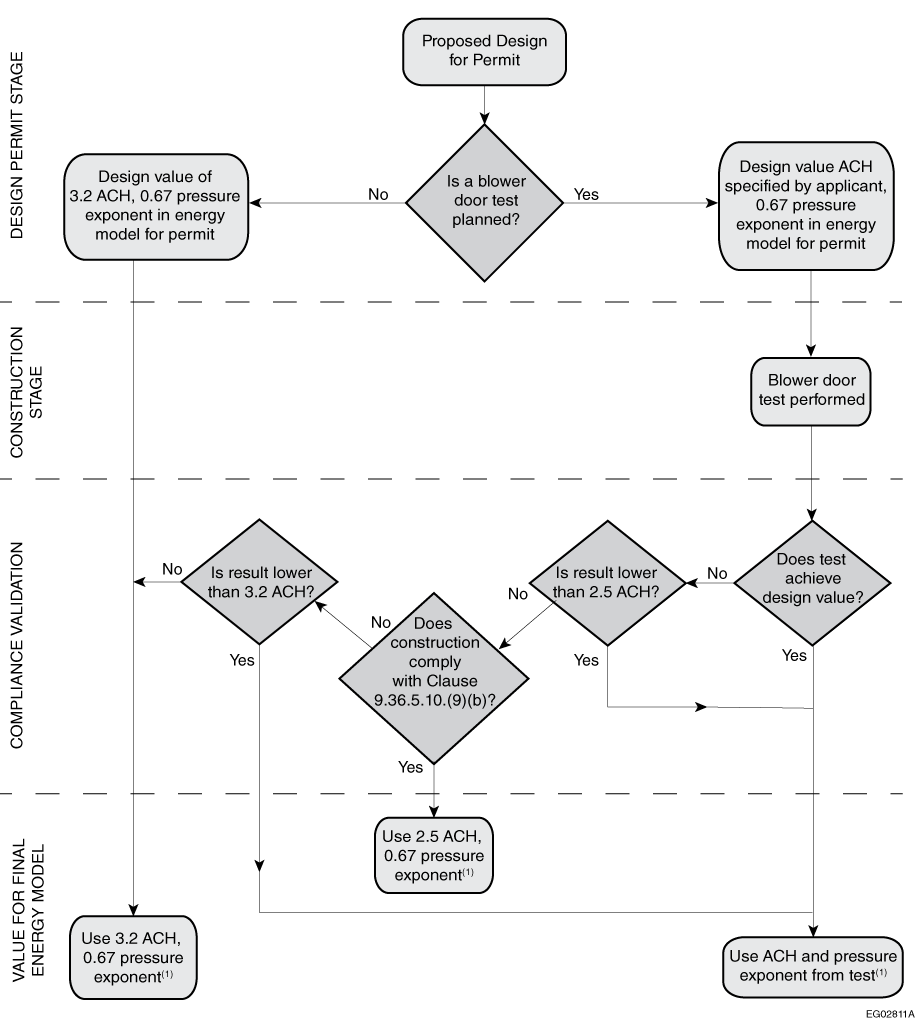
The flow chart in Figure A-9.36.7.3.(7) outlines the intended interpretation of Sentence 9.36.7.3.(7). Airtightness testing is voluntary, however, not testing will result in the proposed house model using a default airtightness of 3.2 air changes per hour (ACH) at 50 Pa pressure difference and a pressure exponent of 0.67.
Figure [A-9.36.7.3.(87)] A-9.36.7.3.(7) Determining the appropriate airtightness value to use in the energy model calculations in the tiered energy performance compliance path
Note to Figure A-9.36.7.3.(7):
(1)Airtightness value and pressure exponent of reference house shall be as per Sentence 9.36.6.14.(2).
Where testing is to be carried out, Code users may use a design value for ACH at 50 Pa pressure difference in the proposed house that they expect to achieve upon testing. Good airtightness is a significant contributor to energy-efficient performance and is likely to be needed to achieve the higher energy performance tiers, however, it requires careful detailing and planning. Caution is advised when choosing a design airtightness value, especially for Code users who are not used to delivering highly airtight buildings. Industry resources are available to assist with selecting and achieving a design airtightness.
Once an airtightness test has been performed, Code users may choose whether to use the test result, the default value of 3.2 ACH at 50 Pa pressure difference or, where the requirements of Clause 9.36.6.10.(9)(b) have been met, 2.5 ACH at 50 Pa pressure difference. It is important to note that a tested pressure exponent may only be used in cases where the tested ACH is used.
Impact analysis
This proposed change would assist Code users by providing a benefit that recognizes energy savings where the design of the proposed building includes a heat pump or heat pump water heater to achieve Code compliance.
No additional costs are expected as the result of this proposed change, as it only provides more options for achieving the energy performance targets in Table9.36.7.2. where a heat pump or heat pump water heater is voluntarily installed in the proposed house.
Also, no additional costs are expected as the result of the proposed changes to Tier1, as no consideration was previously given for energy performance compliance achieved through the installation of a heat pump; the proposed house would still have needed to comply with the energy performance target for Tier1 in Table9.36.7.2. A heat loss reduction target of ≥0% would still permit Code users to use the trade-off performance path for building envelope components to optimize the cost of Code-compliant designs.
Enforcement implications
This proposed change can be enforced by the infrastructure currently available to enforce the Code. By removing the exception for the modeling of heat pumps in Tier1, this proposed change adds clarity that facilitates enforcement.
Who is affected
Regulators, builders, designers, engineers, architects, contractors and consultants.
OBJECTIVE-BASED ANALYSIS OF NEW OR CHANGED PROVISIONS